



(Words By Darr Hawthorne) • Drag racing, and motorsports in general, has never been an easy sell. It wasn’t in 1965, it wasn’t in 1985, and it sure isn’t now. Somewhere along the way, we all started pretending it should be.
Here’s the reality: nobody wakes up on a Saturday morning automatically deciding to go to the dragstrip anymore. Families have options, endless options. Youth sports, concerts, beach and lake days, streaming services, backyard barbecues. If you’re not already in their head before the weekend hits, you’re not even in the conversation.
That’s the part too many “motorsports executives” miss. You don’t just open the gates and hope a crowd shows up. You pre-sell the audience. And no, that doesn’t happen with a slick TV Ad campaign, YouTube livestream or a well-produced TV show.
Don’t get it twisted, streaming has its place. It serves the hardcore fans, the racers, the already-converted. But it doesn’t create new spectators. It doesn’t convince a family of four to pile into the SUV and go spend money at the track. That takes something else entirely.
It takes boots on the ground.
It’s not glamorous. It’s not scalable. It doesn’t come with analytics dashboards or quarterly reports. But it works, and it always has. You want people in the stands? Then you go where people actually are.
You hit the local car shows with stacks of flyers and a limited amount of single-day, two-for-one ticket deals. You walk into auto parts stores, fast food joints, liquor stores, even the places some folks don’t like to mention. You make sure your event is seen. You connect with local museums, vocational schools and what’s left of High School and Community College auto shop programs, because those kids aren’t just future fans—they’re future racers.
You get the local TV weatherman strapped into a nitro car during the 5 and 6 o’clock news and light the thing off. Is it a little goofy? Sure. Does it work? Absolutely.
Because now people are talking.
That’s how you build awareness! Not with perfectly curated social media posts, but with repetition, presence, and a little bit of noise. It’s grassroots. It’s messy. It’s effective.
And here’s the part that might sting: drag racing isn’t Formula 1. It isn’t NASCAR. It isn’t IndyCar. It never has been, and it never will be.
There’s this assumption floating around that drag racing’s biggest problem is awareness. It’s not. People know what drag racing is. The problem is access, and more importantly, friction.
Let me give you a real-world example.
The second drag strip I ever set foot on was Pomona, now In-N-Out Burger Pomona Dragstrip. I absolutely love that place. It’s hallowed ground. But for years, getting there as a casual or rabid fan meant loading up the car, sitting in LA traffic, burning gas, paying exorbitant Fairplex parking fees, and committing to a full-day logistical exercise before you even smelled nitro.
That’s a barrier. A big one.
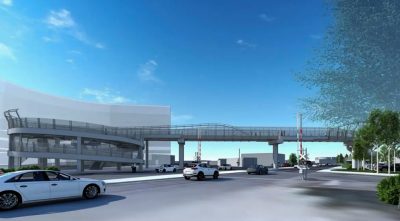
But something changed last September that nobody in the sport is talking about: the MetroLink stop at the La Verne/Fairplex Station. There’s a proposed pedestrian bridge from the new station into the dragstrip parking lot.
Think about what that actually means.
Now a dad and his kid can hop on a train, step off a platform, cross at the stoplight, and walk straight into the drags. No gas. No parking fees. No nonsense. Just buy a ticket and go in.
That’s not theoretical, that’s a turnkey, walk-up audience.
And here’s where the sport needs to wake up.
Why not lean into it? Why not create a simple, no-brainer family pass? Fifty bucks gets a family through the gate for a day at the drags. No overthinking it. No convoluted ticket tiers. Just an easy “yes” come on in.
They can walk over to the Westside grandstands, the ones currently hidden behind giant sponsor tarps, and sit down to watch 330-mph cars try to rearrange the laws of physics. Maybe they skip the pits this first time. Maybe they don’t. Give them the option to upgrade if they want the full sensory overload.
Either way, they’re in the building. And once they’re there? The rest takes care of itself.
They’ll hear it. Feel it. That chest-thumping, ground-shaking violence that no TV broadcast has ever successfully captured. The kid’s eyes go wide. The dad grins like he’s 12 again. Maybe they grab a wildly overpriced event shirt, a toy, an In-N-Out Burger or churro, because of course they do, but that’s not the point.
The point is they’ve been exposed.

That’s how this works. Not with million-dollar ad campaigns or gimmicks—but by removing friction and letting the product do what it’s always done best.
You don’t need to sell drag racing once people are standing at the fence. You just need to make it stupid simple for them to get there.
Trying to package it like other series misses the entire point of what makes drag racing special in the first place. This sport was built at the local level, by local people, for local crowds. Take that away, and what are you left with?
An expensive TV show… or worse, an amateur video feed with no audience behind it, and neither one fills grandstands.
The truth is, you can have the best cars, the biggest names, and the slickest broadcast in the world, but if the seats are empty, the whole thing feels hollow. Because empty seats don’t buy tickets. They don’t buy trackside In-N-Out Burgers. They don’t buy beer. And they definitely don’t come back next time.
Building a crowd isn’t about job titles or marketing degrees. It’s not something you can outsource to a “VP of Promotion” and check off a list. It’s more like politics than people want to admit.
It’s handshakes. It’s conversations. It’s showing up, over and over again, until people know who you are and what you’re bringing to town. And you pray for great weather!
It takes work. The kind of work that doesn’t scale neatly, doesn’t trend online, and doesn’t look impressive in a boardroom. But fills seats. And at the end of the day, that’s the only metric that really matters. Famed drag racing promoter Bill Doner used to say, “The empty seat doesn’t buy a hot dog”.
Because an empty seat doesn’t buy a damn thing.
The post Boots On The Ground: How To Actually Fill A Dragstrip In 2026 appeared first on BangShift.com.


There are no reviews to display.