


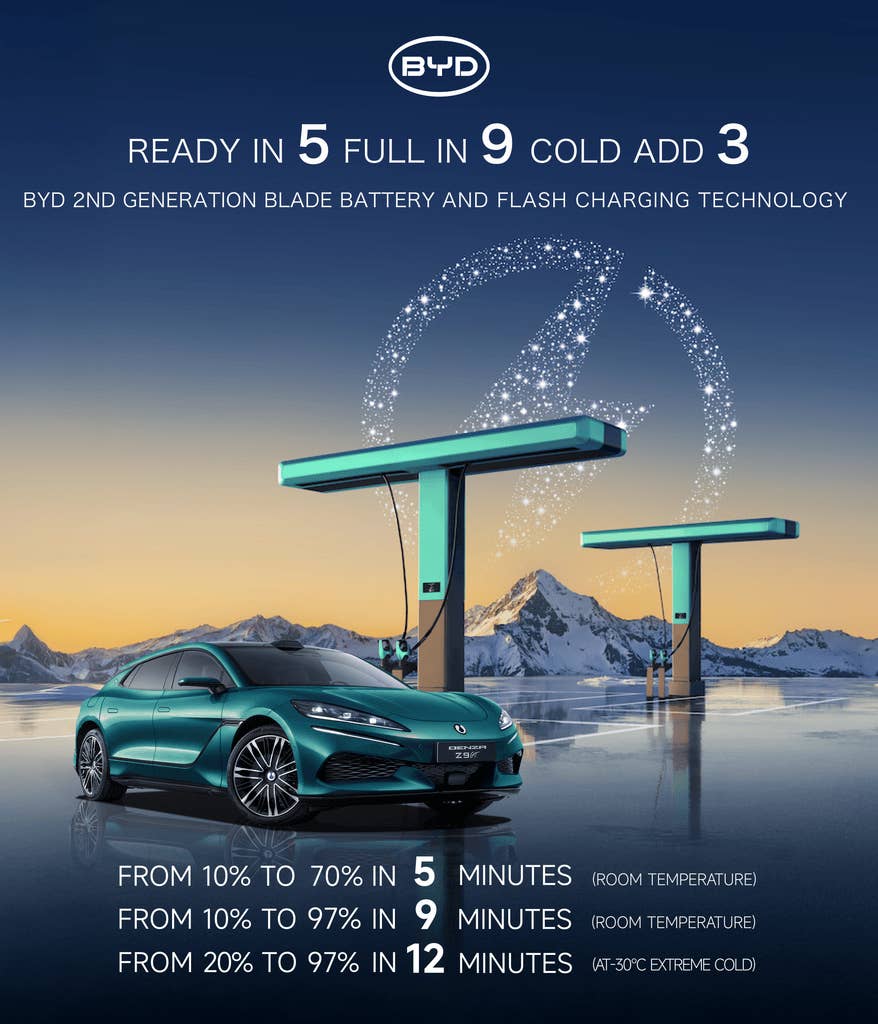
Nine minutes to fully charge an EV and drive 600 miles isn't a marketing exaggeration. It required BYD to rebuild nearly everything to bring EV charging on par with the time taken to fuel up an internal combustion engine vehicle. The foundation of BYD's Flash Charging is a 1,000V electrical architecture that lets the system push enormous power without the current climbing to dangerous levels. Nothing about this was off-the-shelf. BYD had to manufacture components that simply didn't exist. There's a new generation of silicon carbide power chips rated to 1,500 volts, redesigned electric motors, reworked motor controllers, and even a new HVAC system built to handle the thermal consequences of dumping a megawatt into a battery. The chargers themselves, now rated at up to 1,360 kW, suspend cables from overhead towers so drivers don't wrestle with the weight of cables thick enough to carry that kind of load.
The Chemistry Change That Makes Speed Safe
At the cell level of the Blade Battery 2.0, BYD shifted from standard lithium iron phosphate to lithium manganese iron phosphate, picking up roughly 5 per cent more energy density while holding onto LFP's thermal stability. What makes fast charging dangerous is heat, specifically the heat generated when ions move rapidly through a battery's internal resistance. BYD's FlashPass ion transport system cuts the internal resistance of its LFP cells by 50 per cent, which directly reduces heat buildup during charging, letting the pack accept far higher currents than before. The electrodes, electrolytes, and separators have all been redesigned around this goal. The result is a cell that can sustain a charge rate of 10C, more than double what the fastest American EVs manage at peak.
Denza
Heat Management Is Where This Either Works or Doesn’t
Accepting a megawatt without cooking the battery is the actual hard problem. BYD's answer is a direct refrigerant cooling system that keeps cell temperatures in check even during the most aggressive charging window. The company claims the reworked Blade Battery 2.0 delivers a 35 per cent improvement in high-temperature lifespan, which is a meaningful claim if it holds up under independent testing. The warranty terms are reportedly unchanged from the original Blade Battery. That's a promise that will be tested hard once real-world users start fast charging this way daily. Of course, widespread coverage will take time, considering everything that's been re-engineered to make EV charging as quick as fuelling up a gas car, but the promise it brings is worth it.


There are no reviews to display.