




The Corvette ZR1 Makes More?
Automakers typically advertise crank horsepower, which is always higher than wheel horsepower due to drivetrain losses. So when Hennessey Performance dyno tested a stock Chevrolet C8 Corvette ZR1 and recorded a peak output of 1,050 horsepower, the result immediately raised eyebrows.
Chevrolet lists the C8 Corvette ZR1 at 1,064 horsepower from the factory, a figure that represents crank output. Under normal circumstances, wheel horsepower should be noticeably lower once drivetrain losses are factored in. However, the dyno used by Hennessey Performance measures wheel horsepower, making the recorded 1,050-hp result difficult to explain on paper. If the tuner’s findings are taken at face value, it suggests the ZR1’s actual crank output could be substantially higher – potentially in the 1,100- to 1,200-horsepower range.
Exceptional Performance Machine
Peak power was recorded at 6,960 rpm, while the torque curve topped out at 821 lb-ft at 4,810 rpm. Since the test vehicle was completely stock, the engine in question was Chevrolet’s 5.5-liter twin-turbocharged flat-plane-crank V8, currently regarded as the most powerful engine ever fitted to a production Corvette.
The Corvette ZR1 has already backed up its numbers on the track. It has set multiple performance records, including clocking a 6:50.763 lap time at the Nürburgring Nordschleife, beating the 815-horsepower Ford Mustang GTD around the famed German circuit.
So why would Chevrolet deliberately downplay the ZR1’s horsepower – assuming that’s what’s happening? There are several plausible explanations. One possibility is strategic positioning within the lineup. Chevrolet may be careful not to overshadow the Corvette’s even more extreme flagship, the ZR1X, which produces a combined 1,250 horsepower thanks to the addition of a hybrid electric motor driving the front axle. If the standard ZR1 were openly acknowledged to be operating in the same horsepower territory, it could undermine the performance gap – and, by extension, the flagship branding – of the ZR1X.
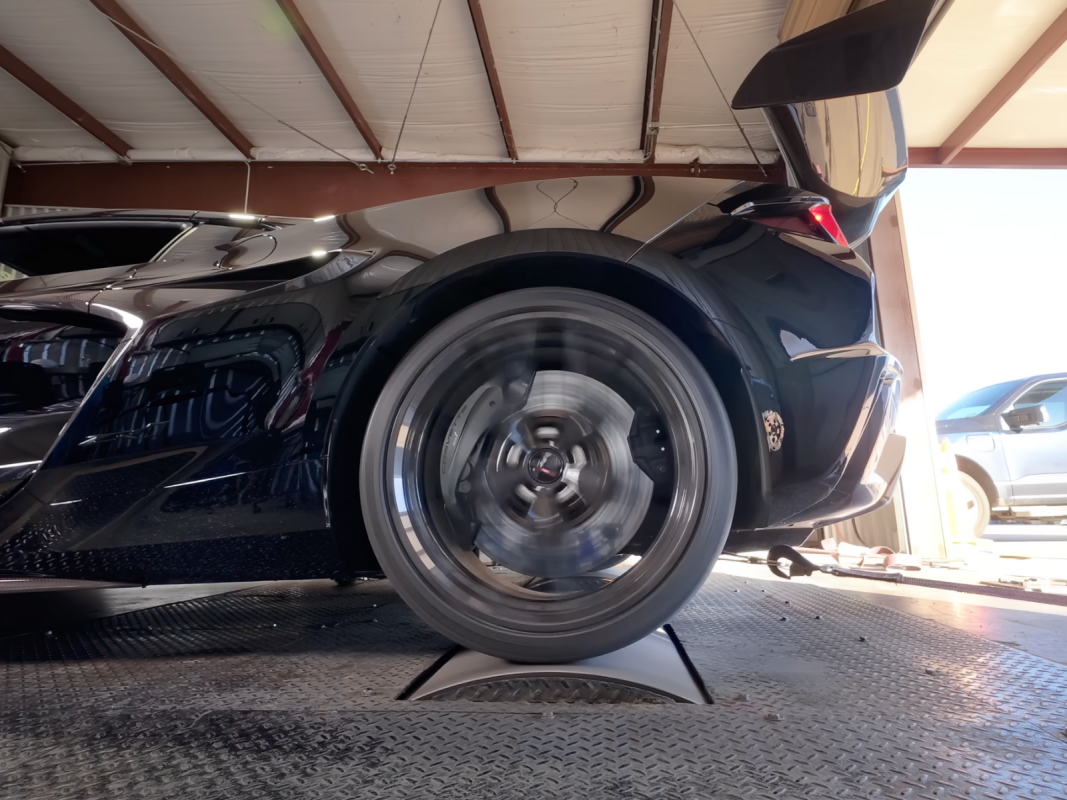
Baseline Set, Now Comes the Fun
Pricing further reinforces that hierarchy. Chevrolet’s consumer site currently lists the Corvette ZR1 starting at $185,000, while the ZR1X is shown at $209,700. While the automaker has not officially capped production for either model, availability may still be limited by supply-chain constraints, particularly for the hybridized ZR1X.
Pinning down the ZR1’s true crank horsepower may ultimately prove difficult. What is clearer is what comes next. Hennessey Performance – the same company known for delivering huge performance improvements as seen in cars like the 2,031-horsepower Venom F5 Evolution – is almost certainly working on a tune that will push the Corvette ZR1 even further. And as with any serious performance project, it all starts on the dyno, establishing a benchmark before the real gains begin.


There are no reviews to display.