




A Clash of Modern Performance Icons
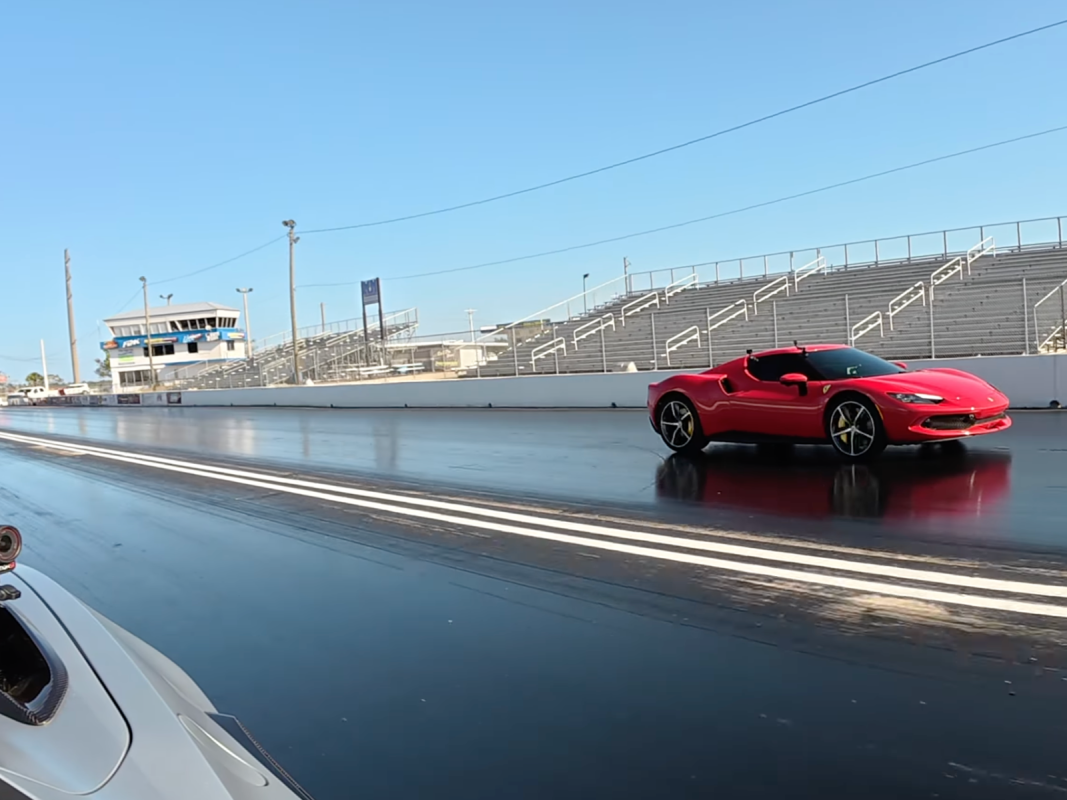
The Chevrolet Corvette ZR1 has delivered since its introduction last year, already racking up multiple performance benchmarks – including a Nürburgring lap time that beat the Ford Mustang GTD. But how does America’s most extreme production Corvette stack up against the tech-forward Ferrari 296 GTB in a straight-line battle? Thanks to DragTimes, we now have a real-world drag race between the two modern performance cars.
The Corvette ZR1 lines up at the quarter-mile with a 5.5-liter twin-turbo flat-plane-crank LT7 V8 producing a staggering 1,064 horsepower. Power is routed exclusively to the rear wheels through an 8-speed dual-clutch transmission (DCT). DragTimes noted that the ZR1 tips the scales at around 3,800 pounds, giving it roughly a 300-pound weight disadvantage compared to the Ferrari.
America vs Italy on the Strip
However, the 296 GTB makes less power, producing a combined 820 horsepower from its 3.0-liter twin-turbo hybrid V6 – the powertrain Ferrari says offers advantages over a traditional V12. The engine itself carries genuine motorsports credibility, with architecture closely related to the V6 platform Ferrari uses in its Le Mans-winning 499P. But the big question is whether that pedigree translates into outright straight-line performance.
During the first run, the Corvette ZR1 won, completing the quarter mile in 9.291 seconds at 153.20 mph. The 296 GTB followed with a 9.737-second pass at 146.08 mph. While the margin may appear small on paper, a difference of nearly half a second in drag racing terms is considered a commanding victory.
A second run was necessary to rule out external variables such as driver reaction time. Yet the rematch told a similar story. The Corvette once again came out on top, posting a 9.315-second run at 151.70 mph, while the Ferrari recorded a 9.746-second pass at 145.66 mph.

When Price Enters the Equation
Beyond performance, pricing adds another layer of context. According to DragTimes, the tested 296 GTB carried a price tag of around $405,000 – roughly $174,000 more than the Corvette ZR1. Much of that premium comes not only from hardware and engineering, but also from Ferrari’s exclusivity-driven brand positioning.
The Italian marque even operates under a loosely hierarchical ownership strategy, where customers often begin with entry-level models such as the 296 GTB before becoming eligible for ultra-exclusive offerings like the Daytona SP3. Chevrolet, by contrast, has stated that it does not plan to cap Corvette ZR1 production, though real-world output will remain constrained by manufacturing capacity and component availability.
Ultimately, determining which car is “worth it” comes down to individual preferences. Nevertheless, head-to-head tests like this high-octane drag race provide valuable insight, helping buyers better understand what they’re getting for their money.


There are no reviews to display.